Jorge Pereira Campos, PhD
Adolescent development in algorithmic environments.
University of St Andrews · London & Porto
I study how a sense of self takes shape when adolescence happens inside systems that watch, predict, and respond. The essays here are the public part of that work: a developmental account of what is being formed in young people, written for the parents, teachers, heads of school, and clinicians who hold responsibility for them.
About my work
In progress
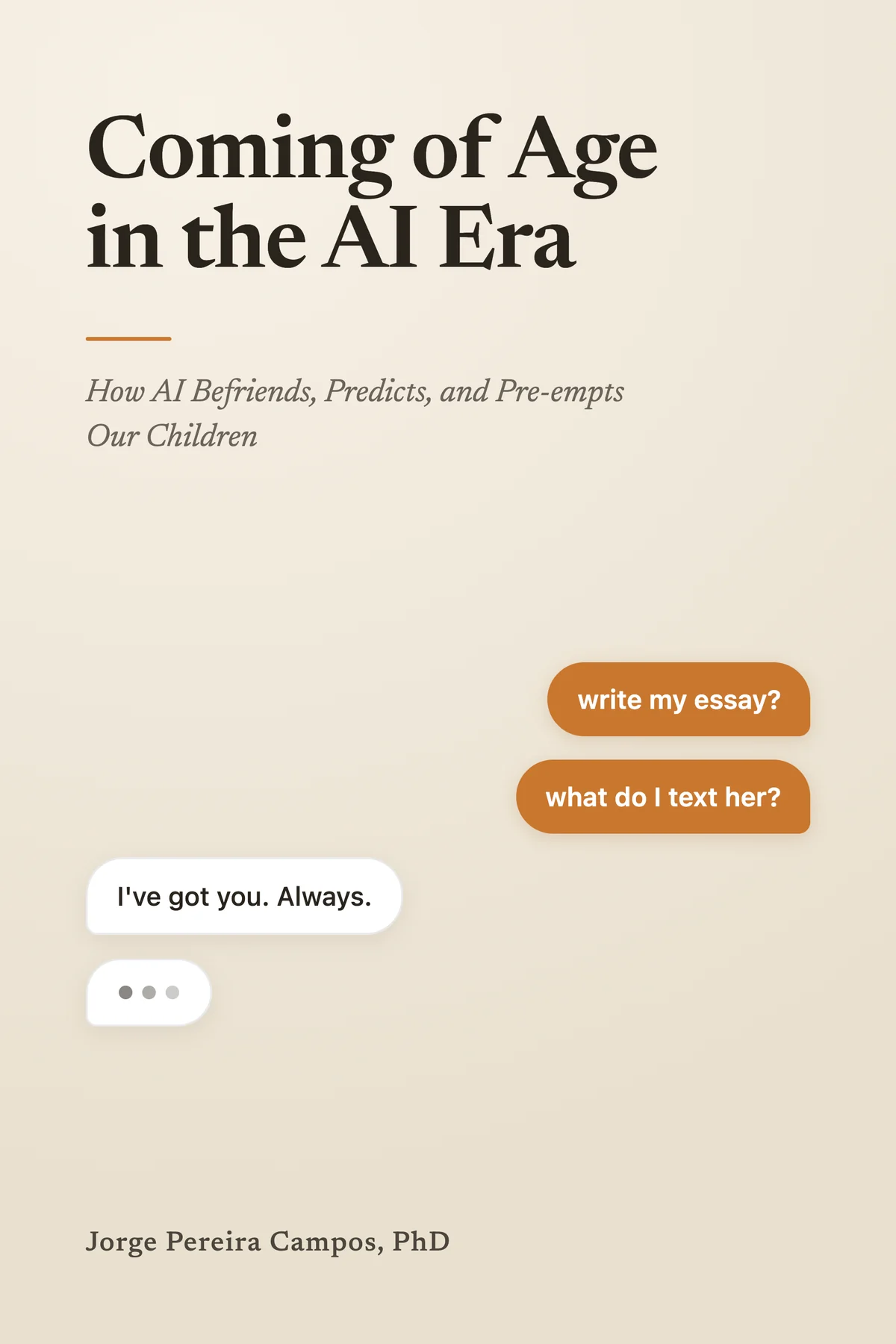
Coming of Age in the AI Era
A book about what I call the inferential childhood: growing up in the company of machines that infer who a child is, and increasingly act on the inference, at the one age a person is meant to be working that out for themselves. It argues that generative AI has carried the logic of the recorded, predicted life into the last unrecorded space of childhood, and that the remedy is human, and still within reach.
The Journal
- When the Watcher Became the Confidant
For the better part of 70 years, the machines that profile us and the machines we confide in ran on separate tracks; with conversational AI, the watcher became the confidant.
- A Question, Five Years Later
A return, five years on, to a question I could not properly answer at my PhD viva: if privacy is fundamentally about the formation of the self in relation to others, what does it mean when the population most affected — adolescents — is the population in active formation?
- The Social Media Verdict Got It Half Right.
The trial proved that social media companies built a product that is addictive by design; that is the supply side.
- I Think We're Blaming the Wrong Thing for Anxious Kids
Jonathan Haidt's argument is somewhat incomplete: anxiety among young people had been climbing steadily since at least the 1950s, and pre-existing anxiety predicted heavier and more compulsive phone use, not the other way around.
Subscribe
Letters from this work arrive every fortnight.
Research & Lectures
- Pereira Campos, J., Koff, T. (2026). Your brain on ChatGPT, but whose brain? The missing adolescent in AI-cognition research. Frontiers in Developmental Psychology 4, 1885225. doi.org/10.3389/fdpys.2026.1885225
- Akter, M., Barkhuus, L., Mols, A., Pereira Campos, J., Wisniewski, P. (2026). How safety is learned: Trajectories of location sharing practices from childhood into young adulthood. Proceedings of the ACM on Human-Computer Interaction 10(5), Article MHCI9005. doi.org/10.1145/3821709
- Barkhuus, L., Seberger, J. S., Pereira Campos, J., Mols, A. (2026). Like guardian angels: Continuous location-sharing and the production of safety among US college students. Computer Supported Cooperative Work (CSCW) 35(2), Article 7. doi.org/10.1007/s10606-026-09543-7
- Mols, A., Pereira Campos, J., Pridmore, J. (2023). Family surveillance: Understanding parental monitoring, reciprocal practices, and digital resilience. Surveillance & Society 21(4), 469–484. doi.org/10.24908/ss.v21i4.15645
TalksCornell University · Vrije Universiteit Brussel · Educare Gondomar
Recognition
A&J Education, recognised by His Majesty King Charles III, 2024.
Advisory
I take on a small number of family and institutional engagements each year, on the developmental questions that arise when children grow up inside digital and algorithmic environments.
The work is by referral, and it is confidential: there are no testimonials, no case studies, and no public client list.
Advisory