psychology
I Think We're Blaming the Wrong Thing for Anxious Kids
Argument
Jonathan Haidt's argument is somewhat incomplete: anxiety among young people had been climbing steadily since at least the 1950s, and pre-existing anxiety predicted heavier and more compulsive phone use, not the other way around. The smartphone only found the anxious generation, it did not create it; the phone is the most visible part of a larger mechanism.
- The 2012 acceleration that Twenge and Haidt later documented is real, but I believe it just sits on top of a trend that was already decades old.
- Anxious people use their phones more, and differently: more checking, more reassurance-seeking, more scrolling to manage anxious internal states they have no other way to manage.
- Taking a teenager's phone without addressing the underlying anxiety tends to produce a more agitated teenager who has lost access to the only regulation tool they had.
- What changed in 2012 was the availability of a regulation tool so powerful, so portable, and so perfectly 'algorithmically' calibrated to the relief-seeking brain that it made the problem impossible to ignore.
- The smartphone only found the anxious generation, it did not create it.
Jonathan Haidt’s The Anxious Generation was a very interesting read. In my opinion, it started a conversation that needed starting, and I am not here to argue that smartphones are harmless. They are most definitely not.
But I think Haidt’s argument is somewhat incomplete.
The mainstream version for those of you who may not have read it: smartphones (and thus access to social media) arrived in children’s hands around 2012, and what followed was a sharp rise in anxiety, depression, and self-harm. The device caused the crisis.
In this post I am going to detail my take, which is different from Haidt’s.
Anxiety was rising before the phone arrived
Twenge's own earlier research showed that anxiety among young people had been climbing steadily since at least the 1950s. The average American child in the 1980s was reporting more anxiety than child psychiatric patients three decades earlier (and this was right after the II World War). This was long before anyone had heard of an iPhone. The 2012 acceleration that Twenge and Haidt later documented is real, but I believe it just sits on top of a trend that was already decades old. To be clear, I am not denying in any way the 2012 inflection, but it sits on top of a trajectory that has little to do with a device.
Something was evidently already going wrong.
The arrow points both ways
Elhai and colleagues (2017, 2018) examined the relationship between anxiety and problematic smartphone use. What they consistently found was that pre-existing anxiety predicted heavier and more compulsive phone use. Not the other way around. Andreassen’s work on social media addiction found the same. Anxious people use their phones more, and differently: more checking, more reassurance-seeking, more scrolling to manage anxious internal states they have no other way to manage.
Taking the phone away doesn’t take the anxiety away
If the smartphone were simply the cause, removing it should reduce (to some extent) the symptoms. Taking a teenager’s phone without addressing the underlying anxiety tends to produce a more agitated teenager who has lost access to the only regulation tool they had.
The same pattern existed before 2012
No matter how much we want to blame Steve Jobs, anxious children did not invent avoidance when the iPhone launched. Before the smartphone there was the television. Before the television there was the radio, the book, the security blanket, the teddy bear. Kubey and Csikszentmihalyi showed in 2002 that anxiety predicted heavier television use. Same mechanism: an uncomfortable internal state, and a device that temporarily made it quiet.
What changed in 2012 was the availability of a regulation tool so powerful, so portable, and so perfectly ‘algorithmically’ calibrated to the relief-seeking brain that it made the problem impossible to ignore. Of course, children’s self regulation mechanisms are still too green to recognise patterns, but the elderly found themselves endlessly scrolling through Facebook and YouTube.
What the nervous system is actually doing
A nervous system that developed in a climate of anxiety and well-intentioned if not emotionally overwhelming care learns very early that discomfort is dangerous. Relief (i.e., the immediate silencing of distress) is the closest thing to safety one has available. This is to all of us a neurobiological pattern laid down in the first years of life.
That nervous system will seek relief from any available source. When the smartphone arrived, it offered social connection cues, variable dopaminergic reward optimised by some of the most well-paid engineers on the planet, distraction from uncomfortable internal states, and portable control. All in one object. All in your pocket.
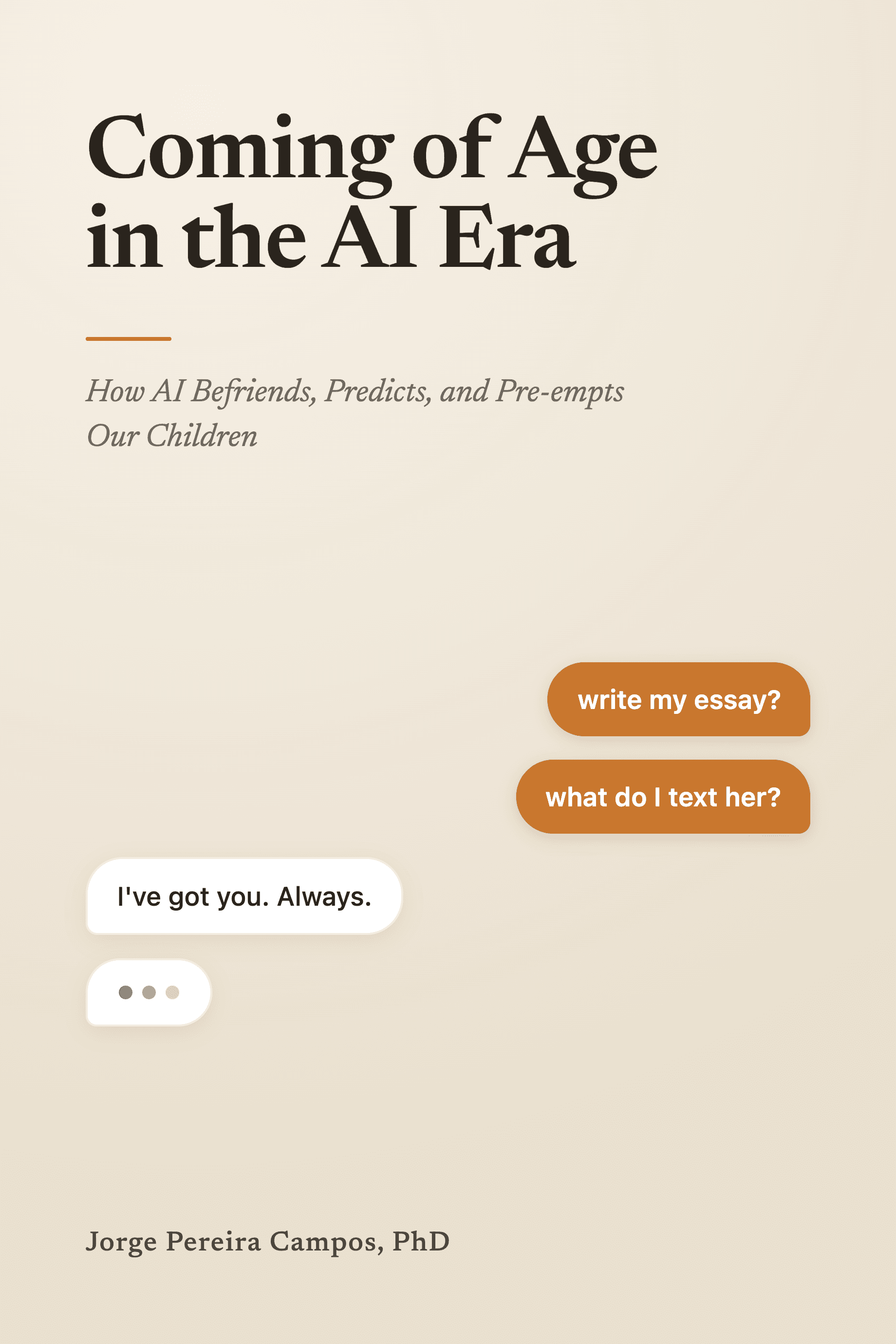
The phone was nothing if not the next evolution of answers to a craving we always had. We might be seeing, speculatively, a similar pattern emerging with AI Assistants who are always there, 24/7, ready to assist you, agree with you, and support you no matter what.
The research is less settled than it sounds
Haidt’s argument is convincing and very solid. It is without any shadow of a doubt a seminal work published to create a much needed discussion. However, I believe, the interpretation of data can be disputed. Orben and Przybylski’s 2019 reanalysis of the same datasets found statistically significant but tiny effects, comparable to wearing glasses or eating potatoes... Candice Odgers, a very respected researchers in adolescent digital behaviour, has repeatedly challenged some of the causal claims.
Specific features of social media, particularly social comparison and the quantification of approval (e.g., the more likes the merrier), do appear to cause harm, especially for adolescent girls. I am not disputing this. However, I believe this is a more precise claim than “the smartphone caused the anxiety crisis”.
Why this matters
If the smartphone is the cause, the solution is straightforward: remove the phone, restrict access, legislate (as many countries, such as Australia, are now doing). It is politically appealing, actionable and gives parents something concrete to do. However, as we all know, teens will always find a way to circumvent these.
If the smartphone is a symptom, what created the anxious nervous systems that were so ready for the phone when it arrived? That question leads to early emotional development, to attachment, to the way we teach children (or fail to teach them) to tolerate distress. It leads to the well-intentioned, loving, quietly overwhelming style of care that produces adults who cannot sit with discomfort and will reach for the nearest source of relief with everything they have (silence is hard, doing nothing is harder).
That is a harder problem than a phone. You cannot legislate it. You cannot confiscate it. You have to understand it.
Haidt is asking the right question. The generation coming of age is struggling in ways that are measurable and alarming. I do not dispute that. What I am saying is that the phone is the most visible part of a larger mechanism. It is the thing we can see, the thing we can point at, the thing we can take away. And taking it away feels like doing something tangible. But if we stop there, we will have a generation of children who are slightly less distracted and exactly as anxious.
The smartphone only found the anxious generation, it did not create it. And until we are willing to look at what made them anxious in the first place - I wager wars, crises, extremely difficult access to housing, amongst a plethora of other things - we will keep solving the wrong problem.
Jorge Pereira Campos holds a PhD from the University of St Andrews, he researches the impact of technology on human behaviour and relationships. He is writing a book called The Relief Trap: Why Your Brain Mistakes Comfort for Safety, and How to Build the Real Thing. You can join the waitlist at book.drjorgecampos.com
References
Andreassen, C. S., Billieux, J., Griffiths, M. D., Kuss, D. J., Demetrovics, Z., Mazzoni, E., & Pallesen, S. (2016). The relationship between addictive use of social media and video games and symptoms of psychiatric disorders: A large-scale cross-sectional study. Psychology of Addictive Behaviors, 30(2), 252–262. https://doi.org/10.1037/adb0000160
Elhai, J. D., Dvorak, R. D., Levine, J. C., & Hall, B. J. (2017). Problematic smartphone use: A conceptual overview and systematic review of relations with anxiety and depression psychopathology. Journal of Affective Disorders, 207, 251–259. https://doi.org/10.1016/j.jad.2016.08.030
Glaesser, J. (2025, February 27). Book review: The Anxious Generation: How the Great Rewiring of Childhood Is Causing an Epidemic of Mental Illness by Jonathan Haidt. LSE Review of Books. https://blogs.lse.ac.uk/lsereviewofbooks/2025/02/27/book-review-the-anxious-generation-how-the-great-rewiring-of-childhood-is-causing-an-epidemic-of-mental-illness-jonathan-haidt/
Haidt, J. (2024). The anxious generation: How the great rewiring of childhood is causing an epidemic of mental illness. Allen Lane.
Kubey, R., & Csikszentmihalyi, M. (2002). Television addiction is no mere metaphor. Scientific American, 286(2), 74–80. https://pubmed.ncbi.nlm.nih.gov/11828703/
Odgers, C. L. (2024). The great rewiring: Is social media really behind an epidemic of teenage mental illness? Nature, 628, 29–30. https://doi.org/10.1038/d41586-024-00902-2
Orben, A., & Przybylski, A. K. (2019). The association between adolescent well-being and digital technology use. Nature Human Behaviour, 3, 173–182. https://doi.org/10.1038/s41562-018-0506-1
Twenge, J. M. (2000). The age of anxiety? Birth cohort change in anxiety and neuroticism, 1952–1993. Journal of Personality and Social Psychology, 79(6), 1007–1021. https://doi.org/10.1037/0022-3514.79.6.1007
Twenge, J. M., Joiner, T. E., Rogers, M. L., & Martin, G. N. (2018). Increases in depressive symptoms, suicide-related outcomes, and suicide rates among U.S. adolescents after 2010 and links to increased new media screen time. Clinical Psychological Science, 6(1), 3–17. https://psycnet.apa.org/record/2017-58243-001
More from the Journal
- Pereira Campos, J. (2026). The Social Media Verdict Got It Half Right. The Journal, March 2026.
- Pereira Campos, J. (2026). The email I didn’t open. The Journal, March 2026.
- Pereira Campos, J. (2026). Why So Many "Bad" Behaviours Are Really About Safety. The Journal, January 2026.

Cite this essay
- APA
- Pereira Campos, J. (2026, March 17). I Think We're Blaming the Wrong Thing for Anxious Kids. drjorgecampos.com. https://drjorgecampos.com/journal/blaming-the-wrong-thing-for-anxious-kids
- MLA
- Pereira Campos, Jorge. "I Think We're Blaming the Wrong Thing for Anxious Kids." Dr Jorge Pereira Campos, 17 Mar. 2026, drjorgecampos.com/journal/blaming-the-wrong-thing-for-anxious-kids.
- Chicago
- Pereira Campos, Jorge. "I Think We're Blaming the Wrong Thing for Anxious Kids." Dr Jorge Pereira Campos, March 17, 2026. https://drjorgecampos.com/journal/blaming-the-wrong-thing-for-anxious-kids.