psychology
A Question, Five Years Later
Argument
A return, five years on, to a question I could not properly answer at my PhD viva: if privacy is fundamentally about the formation of the self in relation to others, what does it mean when the population most affected — adolescents — is the population in active formation?
- Privacy is fundamentally about the formation of the self in relation to others — and the population most affected by changes in those conditions is the population in active formation.
- Adolescents are often more articulate about the mechanics of privacy than adults, but cannot project the consequences of their disclosures forward.
- The architecture of privacy law assumes consent at the moment of collection, but people only construct risk when they can imagine consequences — and adolescents rarely can.
- AI companions, large language models, and recommendation engines have made information asymmetry an ambient feature of childhood, not just a design feature of digital life.
- What the conversation about children and digital systems is missing is a calm developmental account of what is actually being formed in young people inside this environment.
Five years ago, almost to the day, I sat at my desk in Porto whilst on a Teams call with Professor Priscilla Regan and Dr Fergus Neville, and answered questions for about three hours about a thesis I had spent three and a half years of my life writing. The thesis was about cyclists in Milton Keynes who were being asked, by their local council, to share their commuting data in exchange for vaguely defined civic benefits. It had been supervised by Professor Kirstie Ball, who is one of the foremost surveillance scholars working today.
I want to write about what I did not have an answer for at the time. "If privacy is, as you argue, fundamentally about the formation of the self in relation to others, then what does it mean for that formation when the conditions for forming a self change?" I guess my answer at the time was competent. It is not the answer I now think this question deserved.
Five years and a great deal of new technology later, I have been revisiting it. The question I have been turning over is what happens when adolescents replace adults as the relevant population. They are in the active formation of a self. Their every disclosure is being captured by systems whose downstream uses they cannot yet perceive.
Some of this revisiting has been by going back to the original data, which I now read differently from how I read it in 2020. Some of it has been by sitting with teenagers, which I have been doing for several years in my work at A&J Education. Important to clarify that I am not a clinician, and the conversations I have are not formal research interviews. They are coaching conversations, university-admissions conversations, conversations about what the teenagers are reading and how they are sleeping and what they think the world is going to look like when they are thirty. I have now had probably more than two hundred of them. They are the most attentive empirical work I have done since the PhD.
The teenagers I speak to are, on average, more articulate about their own privacy than the adults I interviewed in 2019. They use a more sophisticated vocabulary. They know about cookies and trackers and dark patterns and the uses, and commoditisation, of attention. They are not naïve in the way the discourse about them often suggests. What they cannot do, even when they are extremely intelligent, is project the consequences of their disclosures into the future. They cannot see what their data will mean in five years. They cannot see what an AI companion will do with what they have told it, or what a model trained on their adolescence will know about them when they are forty. Whilst the information they are giving is, to them, entirely visible, the use that information will be put to is, to them — and in all honesty to all of us — entirely invisible.
The adults I studied half a decade ago did not perceive risk at the moment of disclosure. They perceived it only when they could imagine the consequences of the disclosure. If they could not imagine the consequences, the disclosure felt costless — in a very bare way; it was slightly more complex than this. The whole architecture of privacy law, which rests on the idea that consent at the moment of collection is the locus of the ethical question, was misaligned with how the people I studied actually constructed risk. That was one of the findings of the thesis, and it was what Daniel Solove and Helen Nissenbaum had been arguing about, in their own ways, for years.
The cyclists, however, were thirty-five to forty-nine years old. Their perceptual horizon for consequences, however limited, was settled. They could imagine, in general, what kinds of things might happen. The adolescents I now spend my time with are something else entirely. They are building the perceptual horizon as they go. The capacity to project consequences forward is not something that arrives at puberty. The prefrontal cortex, which does much of the work of long-horizon thinking, does not finish maturing until somewhere in the mid-twenties or thirties, as some now argue. And in the meantime, the disclosures the developing person makes, in the building of an identity, are being captured at industrial scale by systems whose memory is permanent and whose inferential power is still rising. Their intentions, if that is even the right word, are not legible to the person doing the disclosing.
The thing I now think I should have said to Priscilla Regan is something like this.
If privacy is fundamentally about the formation of the self in relation to others, then the population most affected by changes in the conditions of privacy is the population in active formation.
The developmental psychology of how a self gets made under these new conditions is the question my thesis was kind of asking and could not, by its design, answer.
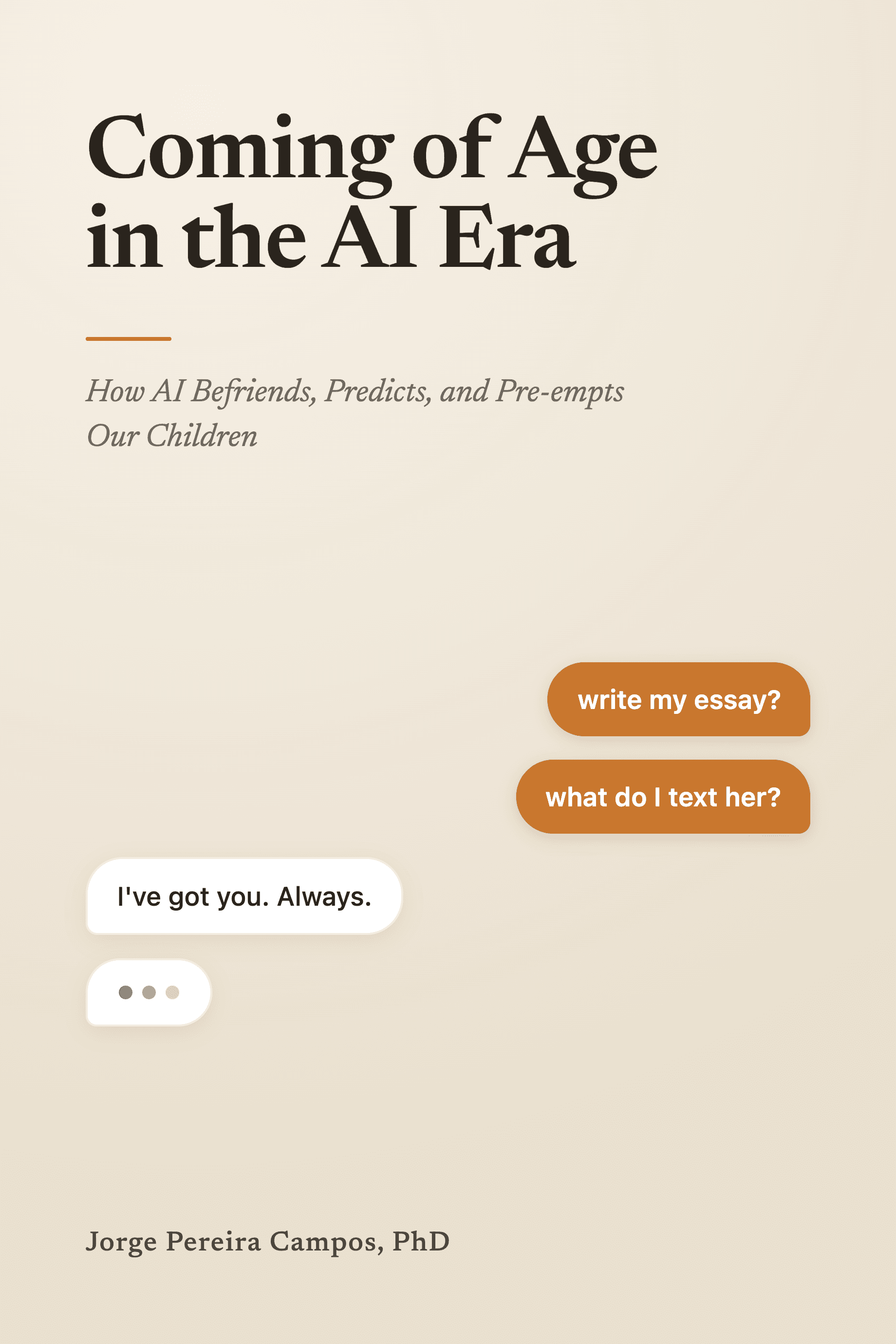
Five years on, I have a different vocabulary for it, partly because I have spent those five years closely with the right population, and partly because the world has obliged by introducing a class of systems that has made the question urgent in a way it was not in 2021. Large language models talk back. AI tutors and AI companions hold memory. Recommendation engines shape. The information asymmetry that ran through my thesis was an architectural feature of digital life that all of us have grown accustomed to. It has now become an ambient feature of childhood.
The discourse on what is happening to children online has been dominated, productively in some places and destructively in others, by writers operating in a register of alarm. Jonathan Haidt's The Anxious Generation is the most prominent recent example. Some of the alarm is warranted. Some of it I believe is not. What has been missing from the conversation is the calm developmental account of what is actually being formed in children inside this environment.
More to come as I comb through the empirical data I have been collecting — as of writing, two hundred and seventeen teenagers.
More from the Journal
- Pereira Campos, J. (2026). When the Watcher Became the Confidant. The Journal, June 2026.
- Pereira Campos, J. (2025). Living Inside Algorithms. The Journal, December 2025.
- Pereira Campos, J. (2026). The Social Media Verdict Got It Half Right. The Journal, March 2026.

Cite this essay
- APA
- Pereira Campos, J. (2026, April 30). A Question, Five Years Later. drjorgecampos.com. https://drjorgecampos.com/journal/a-question-five-years-later
- MLA
- Pereira Campos, Jorge. "A Question, Five Years Later." Dr Jorge Pereira Campos, 30 Apr. 2026, drjorgecampos.com/journal/a-question-five-years-later.
- Chicago
- Pereira Campos, Jorge. "A Question, Five Years Later." Dr Jorge Pereira Campos, April 30, 2026. https://drjorgecampos.com/journal/a-question-five-years-later.